
Buying Guide - Summer 2026 | sales365days.com
UK homes weren't built for heat. As heatwaves become a seasonal fixture rather than a freak event, portable AC units have shifted from novelty to near-essential. Here's what actually matters when choosing one - and how to avoid overpaying.
Britain is an outlier among developed economies. Less than 5% of UK homes have air conditioning, compared with roughly 90% in the United States and over 60% in parts of southern Europe. The reasons are structural: brick housing, historically mild summers, and high electricity costs made widespread cooling feel unnecessary - until it wasn't.
The Met Office confirmed 2022 as the UK's hottest year on record, with temperatures exceeding 40°C for the first time. Since then, heatwaves have become more frequent. The Climate Change Committee has warned that heat-related deaths could triple by 2050 without adaptation.
Retrofitting central air conditioning into Britain's aging housing stock is expensive and often impractical. Planning restrictions, insulation quirks, and the absence of ductwork make it a non-starter for most households. So the market has filled the gap with plug-in, roll-around units that promise relief without renovation.
Most buyers focus on price. The factors that actually determine whether a unit works for you are room size, noise level, and exhaust hose compatibility.
A portable AC that's underpowered for your room will run constantly and still fail to cool it. Match BTU rating to your room before comparing anything else:
Budget units can produce a persistent low-grade hum - which matters enormously when the primary use case is sleeping through a heatwave. Decibel ratings aren't always advertised, but mid-range and premium models typically invest more in noise reduction.
Efficiency drops sharply if hot air leaks back into the room. Many hoses don't fit UK sash windows neatly. Check hose length and diameter before buying. A poorly sealed installation can cut a unit's effective output significantly.
Here's how the main models currently available in the UK stack up.
Lidl Tronic 3-in-1 - £149 785W, covers 30-45m³. Best for first-time buyers on a tight budget. Watch out for noise levels and limited in-store supply.
Blyss (B&Q) - ~£269 Multiple modes, medium rooms. Best for reliable stock and B&Q accessibility. Watch out for the short 1.5m hose and top-mounted display.
DREO 12,000 BTU (318S) - £399-£599 Up to 20m², quieter operation, app and Alexa control. Best for bedrooms and smart home users. Watch out for the premium price relative to room coverage.
Compare live prices across UK retailers before you buy - availability and pricing shift quickly during heatwaves. Search portable air conditioners on sales365days.com
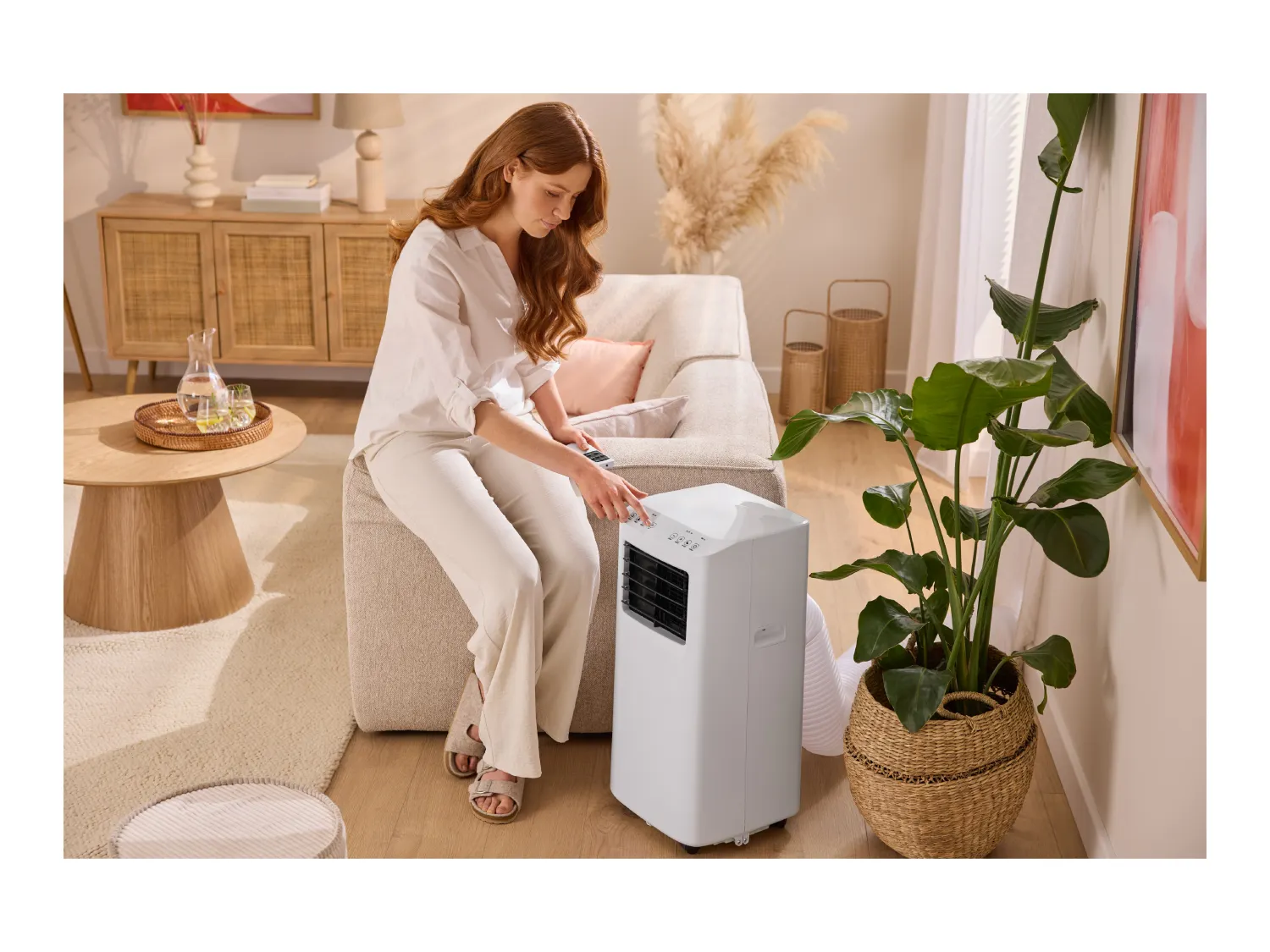
At £149.99, the Lidl Tronic sits at the extreme low end of the market. It cools, dehumidifies, and ventilates - covering a room of roughly 30-45 cubic metres (a small to mid-sized bedroom). Specs are pragmatic: two fan speeds, automatic oscillation, a 24-hour timer, and transport wheels so you can move it room to room.
Power consumption is rated at 785W, which works out to roughly 20p per hour at current electricity prices. Not free, but manageable.
The caveats are real. Lidl's supply strategy leans on scarcity - units are in-store only, available from 25 June, and stocked in limited quantities. If you miss the window, you're waiting for the next delivery. Noise levels are higher than mid-range models, and the exhaust hose rarely fits sash windows perfectly without some improvisation.
Verdict: A solid starting point if you can get one. Don't expect premium comfort - expect a working compromise.
Blyss occupies the middle ground and is widely available through B&Q, which helps on stock reliability. It offers multiple operating modes and a 24-hour timer. The compromises show up in the physical design: a 1.5-metre exhaust hose (short for larger rooms) and a top-mounted display that reviewers often find awkward to use.
Verdict: Better availability than budget options and a step up in build quality. The short hose is a genuine limitation if your window is far from where you want to position the unit.
DREO's 318S targets smaller spaces - up to 20m² - but emphasises refinement: quieter operation, app-based controls, and Alexa integration. These are machines designed not just to cool a room, but to fit into a lifestyle.
The most noticeable upgrade is noise reduction. For bedroom use, quieter operation is arguably the single most valuable feature. App connectivity lets you pre-cool a room before bedtime or adjust settings without getting up at 2am.
One counterintuitive point: higher price does not always mean dramatically better cooling performance. In British rooms, once a unit meets the BTU threshold for the space, additional spending buys comfort around the cooling - quieter operation, smarter controls - not meaningfully colder air.
Verdict: Worth the premium for bedroom use if sleep quality matters to you. Less compelling if you're cooling a living room where noise is less of an issue.
The purchase price is only part of the calculation.
Efficiency tip: Run the unit before bedtime to pre-cool the room, then switch to a fan overnight. This cuts running costs significantly without sacrificing sleep quality.
Budget units are often treated as seasonal appliances - bought in June, stored in September, replaced after a few years. Factor this into the value calculation when comparing price tiers.
Portable air conditioners are a working compromise. They cool individual rooms, not buildings. They increase electricity demand. They rely on user setup that's often imperfect.
But they're accessible - and accessibility matters. For most UK households, a single well-chosen unit will make a meaningful difference during heatwaves.
At £149, the Lidl Tronic is a reasonable entry point if availability works in your favour. If you're buying primarily for a bedroom, spending up to £400 on a quieter model is worth it. Paying beyond that buys smart features more than meaningfully better cooling.
Ready to buy? Don't pay more than you need to. Compare current prices on portable air conditioners across UK retailers at sales365days.com.
Sources: International Energy Agency (AC penetration data), Met Office (2022 temperature records), Climate Change Committee (heat mortality projections). Retail prices correct at time of publication - check sales365days.com for current pricing.